
'Heartbeat Drumming' from Manuel Pasquinelli

Improvisation is often inspired by the feelings and emotions of the artist at the time of the performance, and that is more than especially true of the debut solo album from Swiss drummer Manuel Pasquinelli: 'Heartbeat Drumming' is all at the pace of his own heart, in real time.
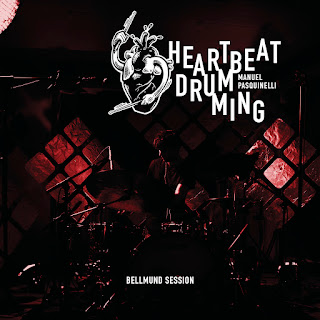

There is something mesmerising and engaging about this album - one track lasting 37 minutes and all recorded in one take.

Swiss drummer Manuel Pasquinelli is widely recognised as the drummer for Sonar and their collaborations with David Torn. Over the past 12 years, he has also gained acclaim as a composer and bandleader with his own group, the AKKU Quintet, and for his work with duo Schrödinger’s Katze.

He says: “Playing the drums in this way is an intense, I’d even say transcendent experience. I take my heart as an unsteady natural metronome, while constantly adapting the pace of my drumming. Connected to my inner beat, I am simultaneously suspended between total freedom and total dependence at the same time, while the conscious and the subconscious ‘me’ work together."

The track is almost an answer to AI - the differences in tempo are heart-driven and intensely human.

Recorded in 37 minutes live in front of an audience at Mazzive Sound Studios in Bellmund, Switzerland, there are no edits or overdubbing, with real energy from the drummer who was connected to a heart-rate belt so that he could hear his own pulse clicking through his headphones.

There feels like a sense of urgency to this music, recorded in the summer of 2020, when the world was a different place: the release of this album in 2025 as we are all analysing the potential positives and negatives of AI seems particularly apt.

Comments

Popular posts from this blog

Big Wade - 'Piano Man' out now

Big Wade and Black Swan Theory collectively blends funk, soul, jazz and everything that fills the cracks between those genres: his new album -  Piano Man - on all major streaming platforms ahead of the Piano Man Tour 2024 , which has dates across the US. Piano Man  brings a selection of original and covers, including a stunning version of Autumn Leaves , which reinvents the song as the funky, electronic Autumn . Big Wade's voice takes the song's melody and improvises around and around, with backing vocals and a deliberately sparse arrangement underpinning the song. Similarly, on Children of the Ghetto , the lead and backing vocals blend in with the soulful musicians of Black Swan Theory. Electronics are used with dexterity, often expanding the vocal lines, as in the ethereal and ghostly opening of Don't Let Me Go . However, the tools never dominate - simply adding depth and layers to the funk. Never more than when Big Wade enters a new world in Interludes , including vocals...

Playtime: 'Morse Code Through The Lights'

Every once in a while, an album drops into your inbox and isn't going anywhere. Morse Code Through The Lights is just such an album. Incontrovertibly controversial, this won't be everyone's cup of tea, but this one has absolutely, instantly, made it onto my list of top albums of 2024. Drummer Tom Bancroft and his band Playtime, which began in Edinburgh as Adventures in New Music ten years ago as a weekly session, have produced something delightfully experimental and brilliantly creative. Four of Scotland's most-established jazz musicians - Martin Kershaw (sax), Graeme Stephen (guitar), Mario Caribe (bass) and Tom Bancroft (drums) - tried out new music and new ideas together. Once lockdown struck in 2020, they decided to explore the possibilities of improvising music together online, partly for something to do, and partly because it was something they could do for their audience. Most of us discovered - or thought we had - that improvising online was difficult or impossi...

36 years ago today, my alto sax was stolen

Actually, it wasn't so much stolen as taken in error.    But at the time, we thought it had been removed from backstage at Amsterdam's De Meervaart venue, where I was on stage with The Style Council.     Luckily, the gig was being broadcast on radio and the support act were listening as they drove away. They soon realised the mistake and returned my sax and all was well.     It was the last gig of a great tour - Paul Weller's first European shows since breaking up The Jam.     Another benefit of the radio broadcast is the recording that exists of that show. A good friend of mine - Iain Munn, author of the definitive history of The Style Council, Mr Cool's Dream - gave me a copy several years ago.     Still a good story, after all these years.